The Key Components of Backtracking
The Key Components of Backtracking
Backtracking is a way of solving problems by trying things out. You make a choice, see where it leads, and if it leads to a dead end, you go back and try a different choice. To understand how this really works, it helps to break a backtracking solution into its main parts.
A problem must satisfy three conditions before backtracking is a good fit. When all three are present, they naturally produce something called a state space tree, which is the backbone of the whole solution. Let's look at each piece.
1. A Finite Set of Outcomes
Backtracking is a brute-force technique. "Brute force" just means we don't use a clever shortcut — instead we are willing to generate and check every possibility one by one.
For this to work, the problem must have two qualities:
- Deterministic — the same choice always gives the same result. There is no randomness. If you pick the digit
0, you get0every time. - A finite set of outcomes — the list of possible answers must come to an end. If there were infinitely many possibilities, we could never finish checking them all.
Think of a 4-digit phone password. Every position can be a digit from 0 to 9, and there are only 4 positions. That gives a fixed, countable number of possible passwords. It is large, but it ends — so it is a finite set. Somewhere inside that big set of possibilities sits the one true solution we are looking for.
2. A Way to Validate a Solution
Generating every possible outcome is only half the job. We also need a way to check each outcome and ask: *"Is this one actually a valid solution?"*
This check is done by a validation function. You hand it one outcome, and it answers in one of two ways:
- This is a valid solution ✅
- This is not a valid solution ❌
For the password example, the validation function would take a guessed 4-digit code and report whether it unlocks the phone. Without such a function, we would have no way to tell a correct answer apart from a wrong one. So every backtracking problem needs some rule or function that recognizes a solution when it sees one.
3. A Recursive Structure
Backtracking builds an answer step by step. You start from the original problem, make one choice, then make another, and keep going. Each choice turns the problem into a slightly smaller version of itself.
But what happens when a series of choices leads to a wrong result? You must be able to step back — undo the last choice — and try a different one. This "go forward, then step back" behavior is exactly what recursion gives us for free.
Here is why recursion fits so well:
- Every function call is one choice. Calling the function means "I commit to this option and move forward."
- The function call stack remembers all the choices. The stack is like a stack of plates — each call sits on top of the one before it. So the path of choices from the start to where you are now is always recorded.
- Returning from a call steps back one level. When a function call finishes, control goes back to the function that called it. From there you can make a *different* choice by calling the function again with different inputs.
So the pattern is: make choices while going ahead, and backtrack and update choices when a path fails. The problem shrinks into smaller problems until it reaches a base case — the simplest version where no more choices are needed.
How These Combine: The State Space Tree
When you run a backtracking solution, all the choices you make and unmake naturally form a tree. This is called a state space tree.
A "state" is just a snapshot of the problem at one moment — what choices you have made so far. The tree is built like this:
- The root is the starting point, called the problem state (no choices made yet).
- Each branch is one choice you could make.
- The leaves at the bottom are terminal states — complete potential solutions, ready to be validated.
The states in between can be one of two kinds:
- A fulfilling state — a state that *can still lead* to a solution. It is worth exploring further.
- A defying state — a state that *cannot* lead to a solution. The moment we reach one, we stop and backtrack, because going deeper would waste time.
We decide whether a state is fulfilling or defying using a rule that is specific to the problem. (Note: not every backtracking problem needs to label its states this way — some simply explore all paths.)
The algorithm explores the tree like this: start at the root, walk down through fulfilling states, and backtrack the instant you hit a defying state or a dead end. When you reach a terminal state at the bottom, run the validation check, then backtrack again to explore other paths — until every possible solution has been found.
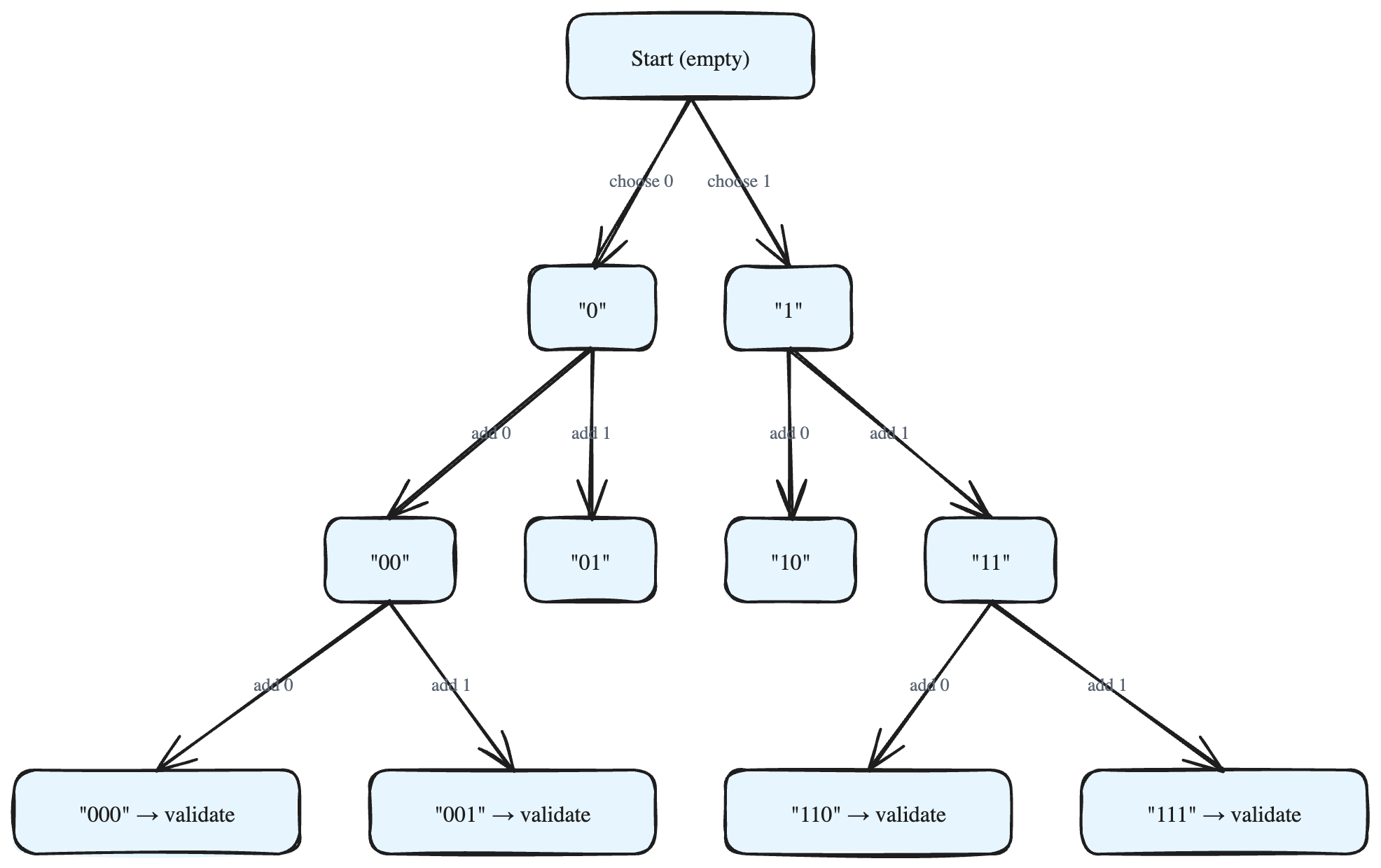
The Tree for the Phone Password
Picture the 4-digit password problem, but simplified to digits 0 and 1. Starting from the empty problem state, each level adds one more digit:
- Level 1: choose
0or1→"0"or"1" - Level 2: add another →
"00","01","10","11" - Level 3: →
"000","001", ..."111" - Level 4 (leaves): full 4-digit codes like
"0000","0001", ..."1111", each one ready to validate.
Every leaf is a complete password we can test. In this particular example, there are no defying states — every partial code could still grow into some valid full code, so we never have to cut a branch early. We simply build all the codes and validate each one at the bottom.
This is the heart of backtracking: a finite set of outcomes gives us a tree to explore, a validation function tells us when we have found a real answer, and recursion lets us walk down the tree and step back whenever we need to.