Insert Interval: Adding a Range and Merging Overlaps
Insert Interval
What is an interval?
An interval is just a pair of numbers that marks a *start* and an *end* on a number line. We write it as [start, end]. Think of it like booking a meeting room: [1, 4] means "busy from 1 o'clock to 4 o'clock."
In this problem you are given a list of intervals like:
[[1, 4], [6, 7]]Two important promises are made about this list:
- Sorted — the intervals are already in order by their start time. The first interval starts earliest.
- Non-overlapping — none of the existing intervals touch or cross each other. They are clean, separate ranges.
The task
You are handed *one new interval* and asked to slot it into the list. After inserting it, some ranges might now bump into each other. Wherever that happens, you must merge them into a single bigger range, and return the cleaned-up list.
What does "overlapping" mean?
Two intervals [s1, e1] and [s2, e2] overlap when:
e1 >= s2In plain words: the first range ends *at or after* the second range begins. If your meeting ends at 4 and another starts at 3, they clash — so they overlap and should be combined into one.
When two ranges overlap, the merged range is:
- start = the smaller of the two starts
- end = the larger of the two ends
Walking through an example
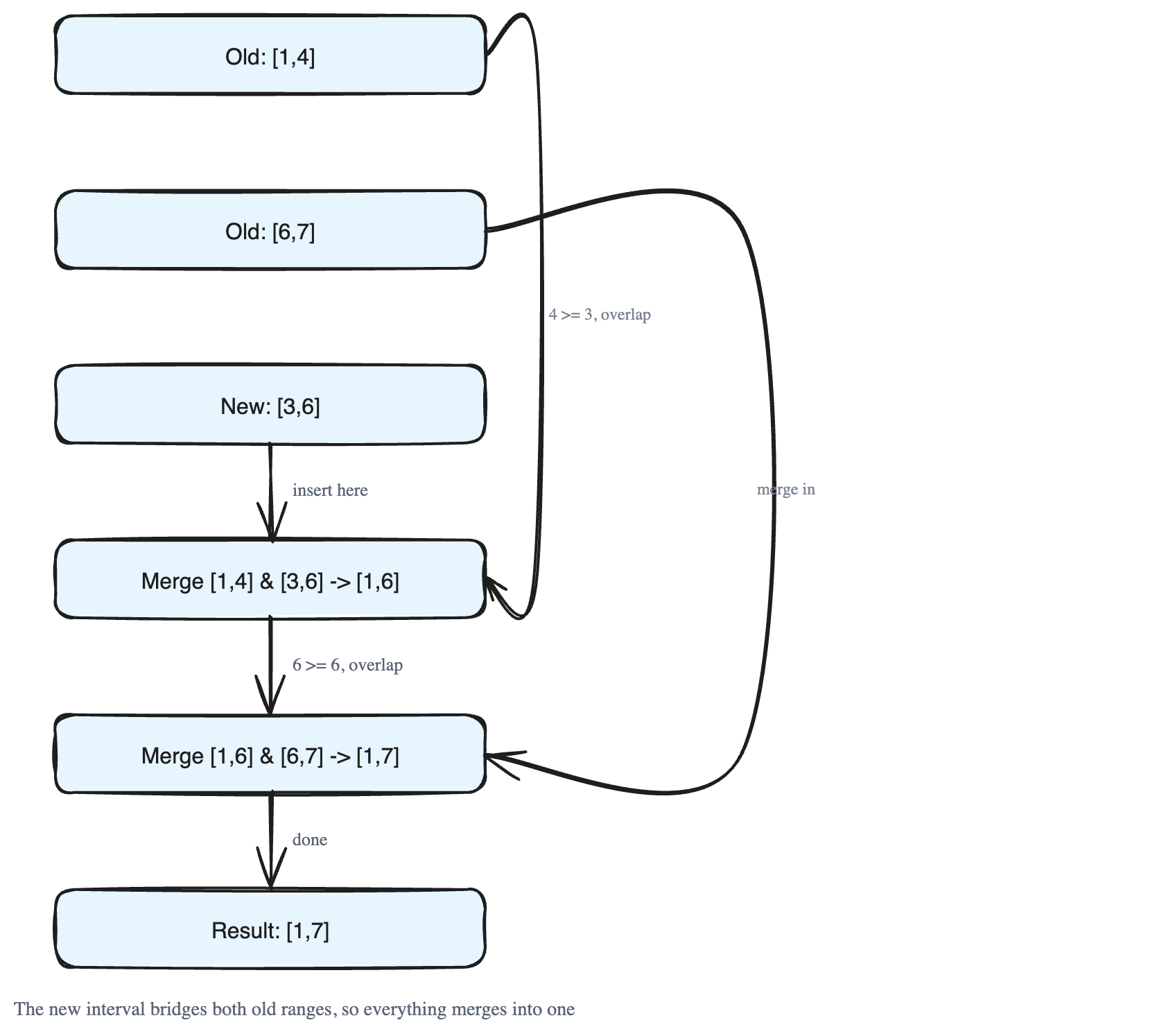
Input:    intervals = [[1, 4], [6, 7]], interval = [3, 6]
Output:   [[1, 7]]
Let's see why the answer is one big range:
- We try to insert
[3, 6]. - Compare with
[1, 4]: does4 >= 3? Yes, they overlap. Merge them → start ismin(1, 3) = 1, end ismax(4, 6) = 6. Now we hold[1, 6]. - Compare
[1, 6]with[6, 7]: does6 >= 6? Yes, they overlap. Merge → startmin(1, 6) = 1, endmax(6, 7) = 7. Now we hold[1, 7]. - Nothing is left, so the final answer is
[[1, 7]].
The new interval acted like a bridge that connected both old intervals into a single range.
The function you must fill in
using namespace std;
class Solution {
public:
    vector<vector<int>> insertInterval(
        vector<vector<int>> &intervals,
        vector<int> &interval
    ) {

    }
};
A clean way to think about the solution in three phases:
- Before — copy every interval that ends *before* the new one starts. These are too early to overlap, so leave them alone.
- Merge — for every interval that overlaps the new one, keep widening the new interval (shrink the start, grow the end) until the overlapping stops. Then add this combined interval once.
- After — copy every remaining interval that starts *after* the new one ends. These are too late to overlap, so leave them alone too.
Because the list is already sorted, you can do all of this in a single pass from left to right.