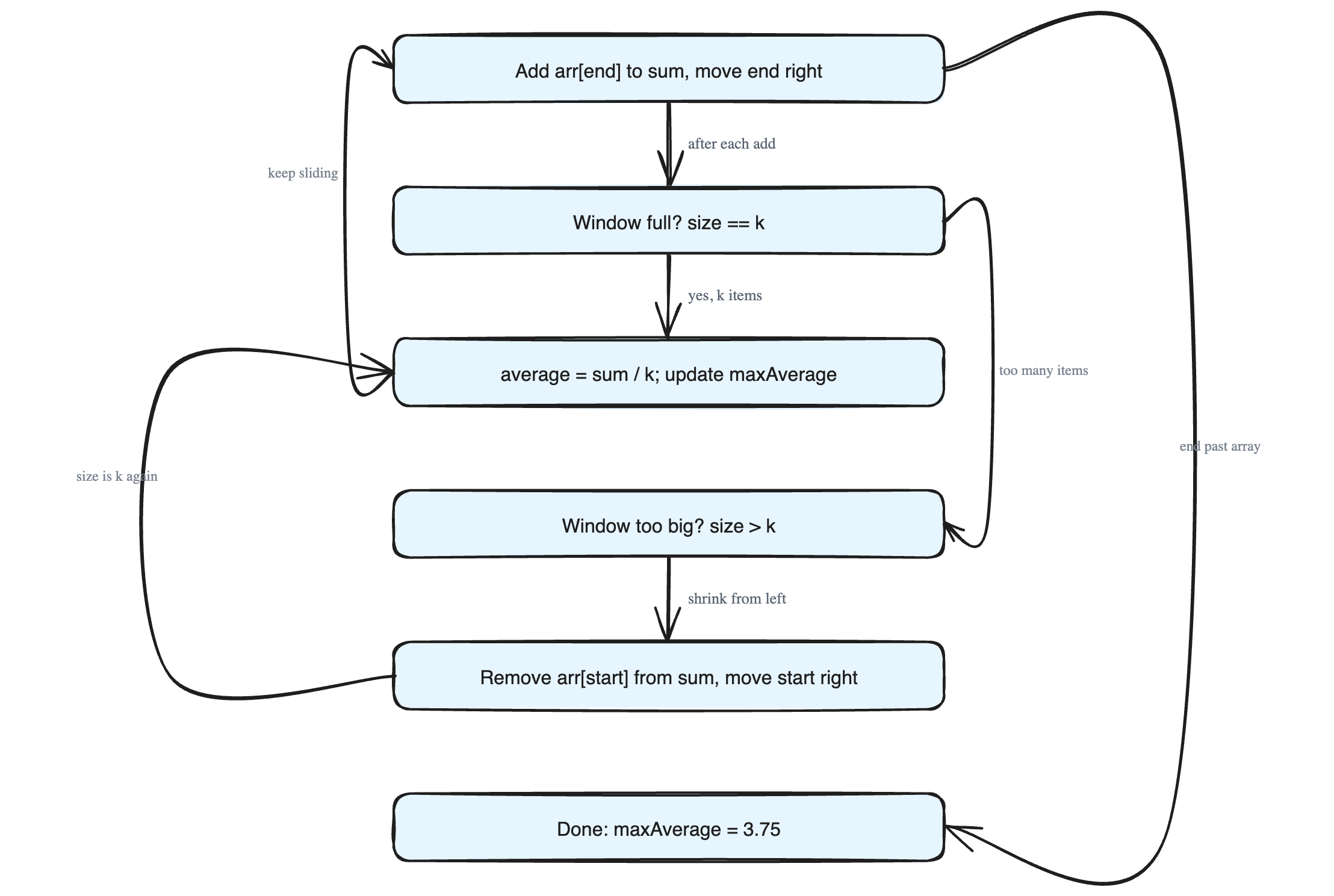
The Fixed-Size Sliding Window Pattern
What is a fixed-size sliding window?
Imagine you have a long row of numbers and you must look at exactly 4 of them at a time. You start with the first 4 numbers, then slide your view one step to the right to see the next 4, then slide again, and so on — like looking through a small window as it moves across the row. This idea is called the fixed-size sliding window technique.
It works on a very specific kind of problem: when you must compute some result (like a sum, average, or count) for every block of k items in a row — these blocks are called *subarrays* of size k. Sometimes you also combine all those results (for example, keep the largest one) to get the final answer.
A subarray is just a continuous slice of the array. For an array [5, 1, 4, 3, 2, 6], the subarrays of size 4 are [5,1,4,3], [1,4,3,2], and [4,3,2,6].
The problem we will solve
> Given an array arr and an integer k, find the maximum average of all subarrays of size k.
We will use arr = [5, 1, 4, 3, 2, 6] and k = 4. The answer turns out to be 3.75.
When does this pattern apply?
A problem fits the sliding window template if:
- You are given an array.
- You must compute some function
f(sum, average, count, etc.) for all subarrays of sizek. - You can add the contribution of a new item and remove the contribution of an old item from that result. (Sum is perfect for this: adding a number and subtracting a number is cheap.)
The slow way first: brute force
The most obvious method uses two loops. The outer loop picks a starting position i (from 0 up to n - k). The inner loop adds up the k numbers starting at i, computes the average, and keeps the maximum.
double kSubarrayAverage(vector<int> &arr, int k) {
    int n = arr.size();
    // Initialize maxAverage to negative infinity
    double maxAverage = -1e9;
    for(int i=0; i<=n-k; i++){
        int sum = 0;
        for(int j=0; j<k; j++) {
            sum += arr[i+j];
        }
        maxAverage = max(maxAverage, (double)sum / k);
    }
    return maxAverage;
}
This is correct, but it does too much repeated work. For every new window it adds up all k numbers from scratch. In the worst case (when k = N/2) this gives a time complexity of O(N²) — slow for large arrays.
The smart way: slide the window
Here is the key insight. When the window moves one step to the right, most of the numbers stay the same. Only one number leaves on the left and one new number enters on the right. So instead of re-adding everything, we just:
- add the new number entering on the right, and
- subtract the number leaving on the left.
We keep a running sum. We never store the average directly — the average is simply sum / k whenever we need it.
We use two pointers, start and end, both beginning at 0. The variable sum is 0 and maxAverage is -infinity. Then we move end across the array.
Step-by-step on [5, 1, 4, 3, 2, 6], k = 4
- Start with
sum = 0,maxAverage = -inf, both pointers at index0. - Add
arr[end]tosum, then moveendforward — keep doing this until the window holdskitems.
- Add
5→sum = 5; moveendto 1 - Add
1→sum = 6; moveendto 2 - Add
4→sum = 10; moveendto 3 - Add
3→sum = 13. Now the window is[5,1,4,3]and its sizeend - start + 1 == k(that is4).
- Window full → compute
average = sum / k = 13 / 4 = 3.25. Since3.25 > -inf, setmaxAverage = 3.25. - Move
endto 4 and add2→sum = 15. Now the window is too big (end - start > k), so we must shrink it from the left. - Remove
arr[start] = 5→sum = 10, then movestartto 1. The window is[1,4,3,2], sizekagain.
- Compute
average = 10 / 4 = 2.5. This is not bigger than3.25, somaxAveragestays3.25.
- Move
endto 5 and add6→sum = 16. Too big again, so removearr[start] = 1→sum = 15, movestartto 2. The window is[4,3,2,6], sizek.
- Compute
average = 15 / 4 = 3.75. Since3.75 > 3.25, updatemaxAverage = 3.75.
endhas reached the end of the array. The final answer ismaxAverage = 3.75.
The pattern in plain words
- Grow the window by moving
endand addingarr[end]. - When the window has
kitems, do your calculation (here: average) and update the answer. - When the window grows past
k, removearr[start]and movestartto keep the size at exactlyk.
class Solution {
public:
    double kSubarrayAverage(vector<int> &arr, int k) {
        int n = arr.size();
        int start = 0;
        int end = 0;
        int sum = 0;
        double maxAverage = -1e9;
        while (end < n) {
            // add arr[end], check window size,
            // compute average when size == k,
            // shrink from start when size > k
        }
    }
};
Why this is better
Each number is added once and removed at most once, so we make a single pass through the array. That gives a time complexity of O(N) — much faster than the O(N²) brute force, and it scales well to big inputs.
More problems that use this pattern
These are usually easy problems where you compute something for every window of size k:
- Subarray size equals K
- Maximum ones
- Negative window
- Even odd count
Once you recognize "compute f for every subarray of size k, where adding and removing one item is cheap," you can reach for the fixed-size sliding window every time.