Finding the Intersection of Two Arrays (With Repeats)
Finding the Intersection of Two Arrays
Imagine you have two shopping lists. You want to find only the items that appear on *both* lists. That shared part is called the intersection. In programming, an array is just an ordered list of values, and the intersection of two arrays is a new array containing only the values found in both.
There is one important twist in this problem: a value can appear as many times as it shows up in both arrays. So if a number appears twice in one array and three times in the other, it should appear twice in the answer — we take the smaller of the two counts.
The Goal
You are given two integer arrays, arr1 and arr2. You must write a function that returns a new array holding their intersection. The order of the result does not matter — any order is accepted.
Walking Through the Examples
Example 1
arr1 = [1, 2, 2, 1]
arr2 = [2, 2]
Output: [2, 2]
The number 2 shows up twice in arr1 and twice in arr2. The smaller count is 2, so 2 appears twice in the answer. The number 1 is in arr1 but not in arr2, so it is left out.
Example 2
arr1 = [4, 9, 5]
arr2 = [9, 4, 9, 8, 4]
Output: [4, 9]
The number 4 appears once in arr1 and twice in arr2 — the smaller count is 1, so 4 appears once. The number 9 appears once in arr1 and twice in arr2 — again the smaller count is 1, so 9 appears once. The number 5 is only in arr1, and 8 is only in arr2, so both are dropped.
How to Think About Solving It
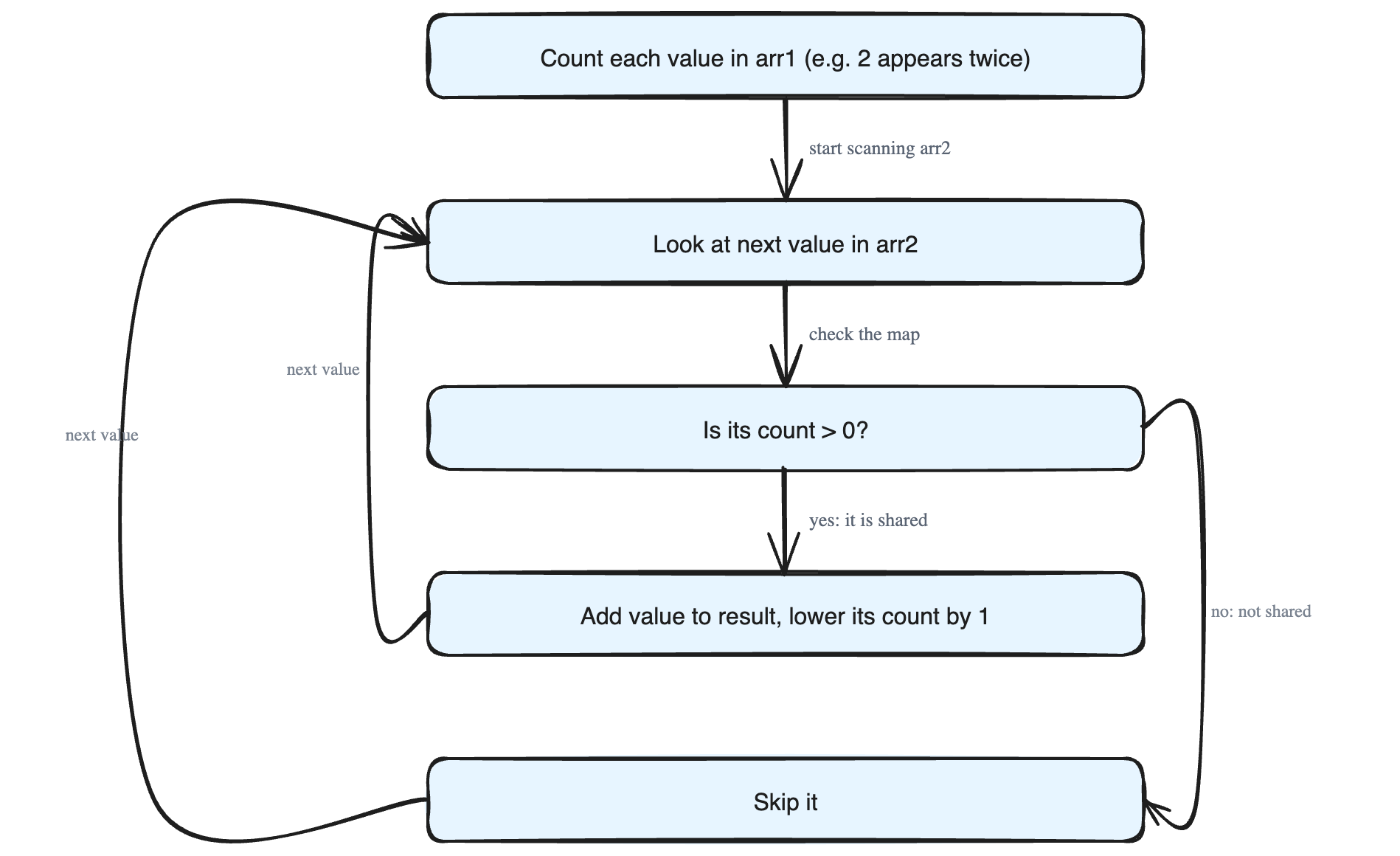
The key insight is "take the smaller count of each value." A clean way to do this:
- Count how many times each number appears in
arr1. A good tool for this is a hash map (a structure that stores a value and a count linked together). - Go through
arr2one number at a time. For each number, check the map. If its count there is greater than 0, add that number to your result and reduce the count by 1. - Reducing the count makes sure each shared occurrence is matched only once, which is exactly why
2came out twice — not three times — in Example 1.
The Code Skeleton
You need to fill in the body of this function:
class Solution {
public:
    vector<int> repeatedIntersections(
        vector<int> &arr1,
        vector<int> &arr2
    ) {

    }
};
It takes two integer vectors (C++'s name for a resizable array) and must return a vector<int> holding the intersection.