Checking if One String is a Subsequence of Another
What is a Subsequence?
Imagine you have a word, and you start crossing out some of its letters. You are not allowed to move any letters around — they must stay in the same order they were before. Whatever letters are left, read from left to right, form a subsequence of the original word.
The key idea is two simple rules:
- You may remove any letters you want (even none, even almost all of them).
- You must keep the order of the letters that remain.
For example, take the word abcde:
aceis a subsequence. Cross outbandd, and the leftover lettersa,c,eare still in their original order.aecis not a subsequence. Even though all three letters appear inabcde, in the original wordccomes beforee. Writing them asaecflips their order, which is not allowed.
The Problem
You are given two strings, s and t. You must write a function that returns true if s is a subsequence of t, and false otherwise. In other words: can you build s by deleting some letters from t without rearranging anything?
The function signature looks like this:
bool subsequenceChecker(string s, string t)Walking Through the Examples
Example 1: s = abc, t = ahbgdc → answer is true.
Let's check it. We try to find each letter of s inside t, moving left to right and never going backwards:
- Find
aint→ it is the first letter. - Now find
b*after* that → it appears a bit later. - Now find
c*after* theb→ it is the last letter.
We found all of s in order, so abc is a subsequence of ahbgdc.
Example 2: s = coin, t = codeintuition.
Try the same scan: find c, then o after it, then i after that, then n after that. Work through the letters of t and check whether the full word coin can be traced out in order.
The Intuition for Solving It
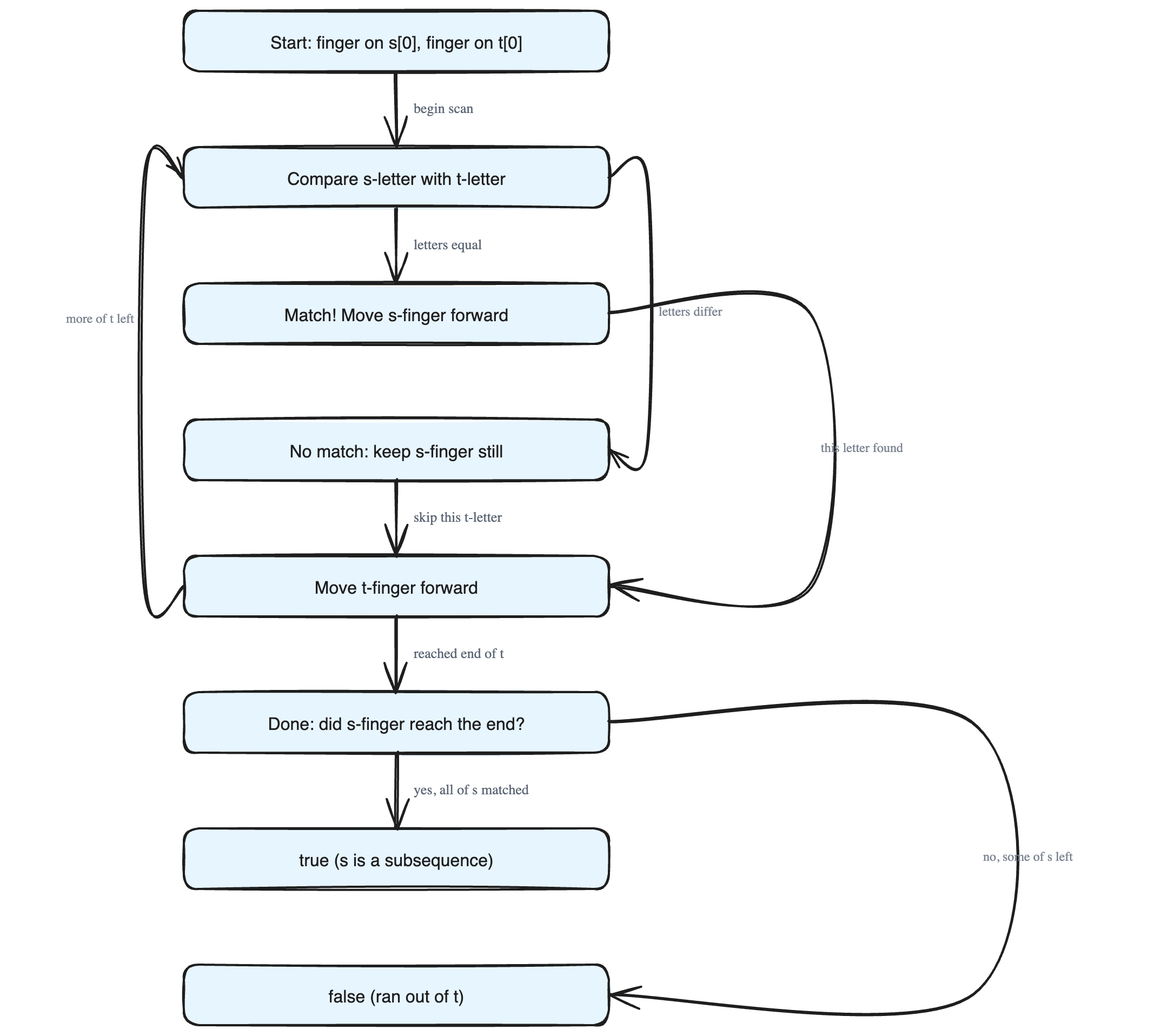
The natural way to solve this is with two pointers — think of two fingers, one resting on s and one walking across t:
- Put one finger at the start of
sand one at the start oft. - Move the
tfinger forward one letter at a time. - Each time the letter under the
tfinger matches the letter under thesfinger, advance thesfinger too (that letter is "found"). - Keep going until you reach the end of
t.
If the s finger reaches the end of s, it means every letter of s was matched in order, so return true. If you run out of t before finishing s, return false.
This works in one pass over t, which is fast and simple.