Why One-Dimensional Arrays Are Not Always Enough
Why One-Dimensional Arrays Are Not Always Enough
So far you have learned about a simple kind of array — a single row of boxes, all holding the same type of data. This is called a single-dimensional array. A single-dimensional array is just a straight line of slots, one after another, where each slot has a position number called an index.
This works great for many problems. But there are situations where a single line of boxes starts to feel clumsy. Let's walk through a real example to see where the trouble begins.
A school full of students
Imagine a school. We want to store the age of every student. The school has classes from 1st standard to 4th standard, and each class has 60 students.
A natural first idea is: make one array for each class.
class1→ an integer array of size 60 (ages of all students in class 1)class2→ an integer array of size 60 (ages of all students in class 2)class3→ an integer array of size 60class4→ an integer array of size 60
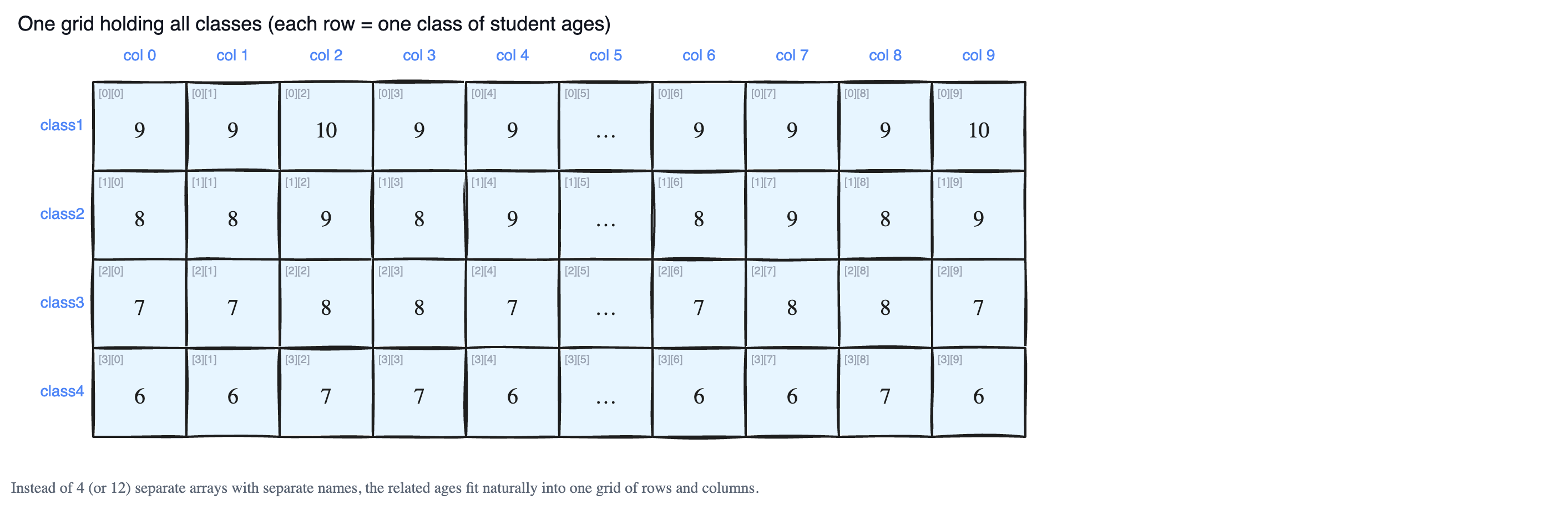
So each class is one straight row of 60 numbers, like 9 9 10 9 9 ... 10 9 9 9 10. Four classes means four separate rows. This is neat and easy to read. So far, no problem.
What happens when the school grows?
Now change one detail. Instead of 4 classes, suppose the school has 12 classes.
With the same idea, you would now need class1, class2, class3, all the way up to class12 — twelve separate arrays, each a different variable with its own name.
It still *works*. But notice how it starts to feel:
- You have to invent and remember twelve different names.
- If the school had 100 classes, you'd need 100 names. This does not scale — meaning it does not grow nicely as the problem gets bigger.
- The code becomes long, messy, and easy to get wrong.
This brings us right back to where we started before arrays existed: juggling lots of separate variables by hand. That defeats the whole reason we use arrays in the first place.
The limitations, stated clearly
Single-dimensional arrays are powerful, but they have real limits when data is naturally grouped:
- Every array needs a unique name. Even though all the classes hold the same kind of data (ages), each must have its own separate name.
- It does not scale. Using one array per group is fine for a few groups, but quickly becomes unmanageable as the number of groups grows.
- Too many arrays make code complex and error-prone. More variables means more chances to make a mistake.
- Relationships get lost. The classes are clearly related — they all belong to the same school. But when they live in separate, disconnected arrays, that relationship is hidden. Nothing in the code says "these twelve rows belong together."
The idea this points to
Notice what the picture really looks like: it is a grid. Each class is a row, and within each row sit the students' ages. What we truly want is a single structure that holds *all* the rows together — one name for the whole grid, not twelve names for twelve loose rows.
Computers are built to handle problems at large scale, and this kind of need shows up even in very simple software. That is exactly why programming languages — even low-level ones — provide built-in support for arrays with more than one dimension. An array that has rows *and* columns is the natural tool for this job, and it is what we will explore next.